
The Subtle Art of the Transfer Flip
What 12 seasons of data reveal about football’s best buy-low, sell-high deals.

Hi friend,
Welcome to Transfer Science #002, the newsletter for people who think “he should have scored” deserves a probability attached to it.
Today, we’re diving into the subtle art of buying low and selling high — the transfer flip.
By the end of this post, you’ll know:
which deals have broken the market in terms of absolute profit;
which transfers have generated the most ridiculous returns on investment;
and which ones might go down as some of the worst deals ever made.
Before we begin
Before we get into the rankings, a few definitions.
For the purposes of this article, we define a transfer flip as a case where a club buys a player for a fee and later sells that same player for another fee.
This means that players who arrive for free, come through the academy, or leave without a fee are not included in the analysis.
We restrict the analysis to players who were 24 or younger at the time of the original purchase. This is important: older players naturally lose value as they age, which would mechanically bias the results.
All transfer fees are expressed in 2026 euros, so figures are comparable across time.
The data comes from Transfermarkt.
Now that we’ve got that out of the way, let’s start with some context.
1 — How common are transfer flips?
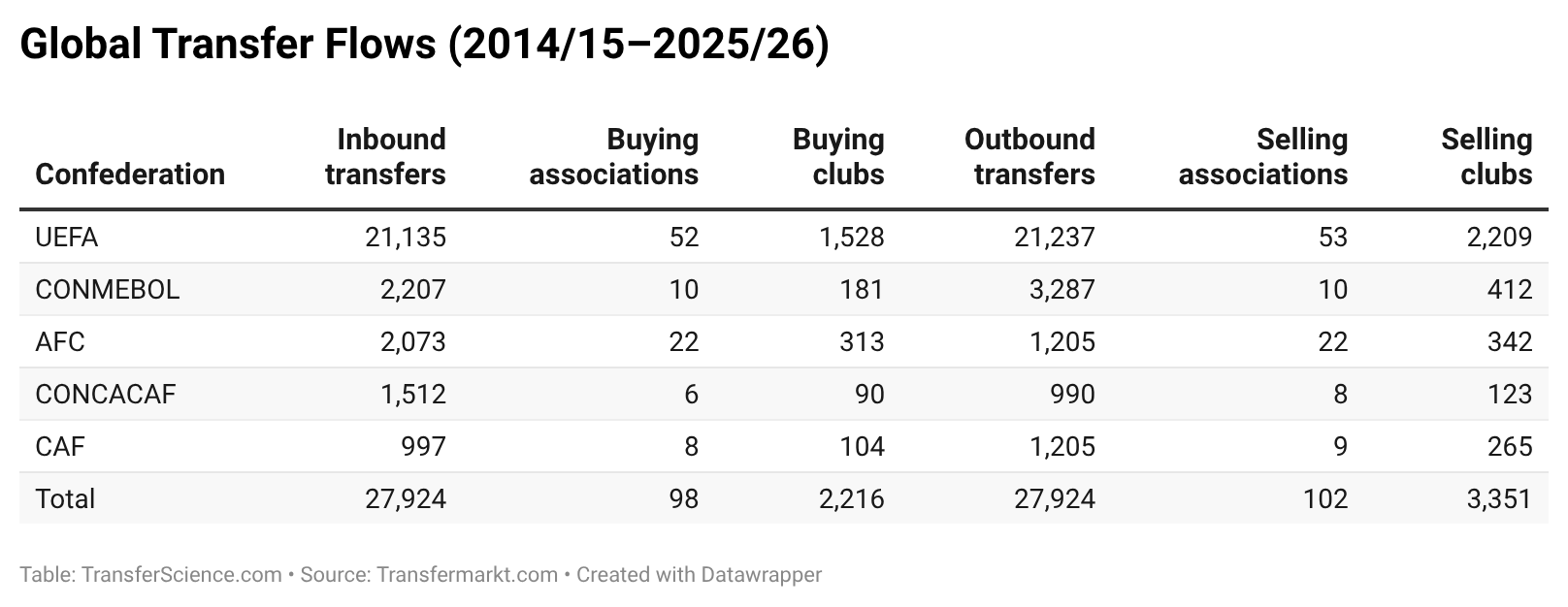
Our dataset spans 12 seasons of transfer activity (2014/15 to 2025/26) and includes close to 28,000 fee-paying transactions across 100 associations.
The table below presents the number of transfers per confederation, along with the number of participating associations and clubs. Overall, a rather comprehensive picture of global transfer activity
However, not all of these transactions are relevant for our analysis.
The key question is:
Out of these 27,924 transfers, how many involve a player who is later resold after being bought once?
In total, 7,938 transfers meet this criterion. Of these, 5,306 involve players who were 24 or younger at the time of initial purchase, which is the subset we focus on in this analysis.
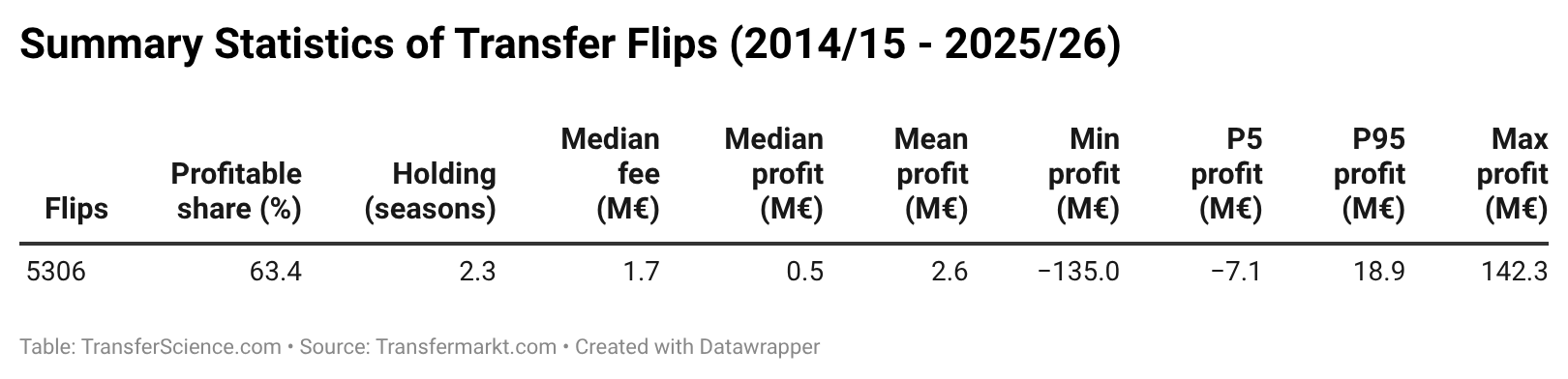
Now delving even further, among these flips:
63.4% are profitable for the intermediary club (the one that bought and sold)
Clubs hold players for an average of 2.3 seasons
As for the fees paid, the median resale fee is €1.7m with the median profit is around €0.5m. On average, clubs flipping younger players generate relatively modest profits.
Most clubs are not printing €20m gains every summer, despite what newspaper headlines might make you think. In practice, the transfer market looks very different: clubs typically make small gains, break even, or occasionally take losses.
The average profit is €2.6m, with extreme outcomes ranging from a €135m loss to a €142.3m gain.
Can you guess which two players are behind those extremes?
Take a guess (you’ll get the answers below — don’t peek just yet 🙂).
2 — The Most Profitable Transfer Flips
Let’s start with the simplest measure: absolute profit.
The way we’ll approach this is simple. I’ll briefly walk you through the 10 biggest transfer flips, ranked by profit generated.
But instead of starting at the top, let’s build up to it.
Because where’s the fun in revealing the winner straight away?
#10 Alisson to Liverpool: the only goalkeeper who made the top 20
At #10, we have the only goalkeeper in the top 20: Alisson.
Roma bought him for around €10.3m and sold him to Liverpool two seasons later for around €90.1m.
A huge profit.
And, unlike some of the other names in this ranking, this one worked beautifully for the buyer too.
Liverpool paid a massive fee, but they bought one of the most valuable pieces of their title-winning machine.
There are no cheap or expensive players. There are valuable players and replaceable ones.
Alisson was very much the former.
#9 Thomas Lemar to Atlético Madrid: the Monaco machine
At #9 comes Thomas Lemar.
Monaco bought him from Caen for around €5.2m and sold him to Atlético Madrid for close to €89.5m after that famous Monaco cycle.
This is the version of flipping that every development club dreams of: buy young, build a title-winning team, create a market frenzy, and sell the pieces at maximum value.
Lemar did not become the superstar some expected him to be. But for Monaco, the deal was a masterpiece.
#8 Enzo Fernández to Chelsea: the fast flip
At #8 comes Enzo Fernández, whose move from Benfica to Chelsea generated roughly €84.6m of profit in just one season.
This is one of the cleanest modern examples of the fast flip.
Benfica paid a premium to get him from River Plate — roughly three times his market value — but then extracted an even bigger premium from Chelsea only months later.
Buy expensive.
Sell even more expensive.
Simple in theory. Very hard in practice.
#7 Antony to Manchester United: Ajax’s flip, United’s flop
At #7 comes Manchester United’s Antony flip flop.
Two seasons of Eredivisie football were enough to turn Antony from a €19.3m winger into a €104.7m sale to Manchester United, generating around €85.4m of profit for Ajax.
Brilliant business for Ajax.
A much more painful one for United.
#6 Moisés Caicedo to Chelsea: Brighton in one transfer
At #6, we have Brighton’s brilliant Moisés Caicedo flip.
Brighton bought Caicedo for a relatively modest fee and, three seasons later, sold him to Chelsea for a profit of around €86.7m.
That is Brighton in a sentence.
Identify the talent early. Develop him. Sell him when the richest clubs start panicking.
Nobody really questions Caicedo’s ability. He is an elite defensive midfielder. But Chelsea paid the fully repriced version of him.
Brighton bought the uncertainty. Chelsea bought the proof.
And proof is expensive.
What you do with that proof, of course, is another story.
#5 Virgil van Dijk to Liverpool and #4 Harry Maguire to Manchester United: same recipe, different endings
Now we enter the €90m-profit zone.
And this is where two centre-backs arrive almost side by side.
Both were bought at similar ages. Both were bought for similar fees. Both were sold two seasons later for enormous profits.
One became arguably the greatest Premier League centre-back of his generation.
The other is Harry Maguire.
Southampton bought Van Dijk aged 24 for €20.2m and sold him to Liverpool two seasons later for €107.1m.
Leicester bought Maguire aged 24 for €17.3m and sold him to Manchester United two seasons later for €106.9m.
From the selling clubs’ perspective, both deals were close to perfect.
Buy a Premier League-ready defender. Let him develop. Let a bigger club convince itself that he is the missing piece.
Then sell at peak market heat.
The buying-club stories, of course, are very different.
Van Dijk transformed Liverpool.
Maguire became a much more complicated case.
But for Southampton and Leicester, the flips were excellent.
Turning a two-season centre-back stint into roughly €90m of profit is the sort of deal every sporting director dreams about.
#3 Jude Bellingham to Real Madrid: Dortmund’s masterstroke
Third comes Jude Bellingham, Dortmund’s first appearance in this ranking — but not their last.
They signed him from Birmingham City for €36.9m, a fee that, at the time, many would have considered aggressive for a 17-year-old midfielder playing in England’s second tier.
Three seasons later, they sold him to Real Madrid, generating close to €95.6m in profit.
What makes this case different is that Bellingham lived up to the hype almost immediately after his move.
He became one of Real Madrid’s key players, spent much of his first season as their leading goalscorer, and helped them win major trophies in his debut campaign.
So this is not a simple story of one club winning and another losing.
Dortmund bought early. Real Madrid bought certainty.
Win-win.
#2 Dušan Vlahović to Juventus: when ROI becomes absurd
Second comes Dušan Vlahović.
Fiorentina bought him for around €4m and four seasons later sold him to Juventus for €102m, generating close to €98m in profit.
The return on investment?
Around 2,464%.
Yes, you read that correctly.
Juventus fans might not describe this transfer as a success story, but for Fiorentina, it was an extraordinary piece of business.
They signed an 18-year-old striker, developed him, benefited from his goalscoring output — especially in his final two seasons — and sold him at the exact moment when top clubs came knocking.
A perfect execution of the transfer-flip model.
What happened next at Juventus is another story.
And now, finally, the winner.
#1 Ousmane Dembélé to Barcelona: the Ballon d’Or Balance Sheet d’Or winner
At the top of the ranking is Ousmane Dembélé.
During the 2016/17 season, Dortmund bought him from Rennes at the age of 19 for around €45m.
One season later, they sold him to Barcelona for €187m.
In inflation-adjusted terms, the deal generated about €142m in profit.
It is hard to imagine many deals ever topping that.
What makes the story even more interesting is the context at the time of the transfer. Dembélé was valued at around €15m, meaning Dortmund appeared to be paying a significant premium — roughly three times his market value.
Who would have guessed that such an investment would turn into the most profitable transfer flip ever recorded?
For Dortmund, the return on investment was around 316%.
Not bad for a single season.
And here’s the complete table.
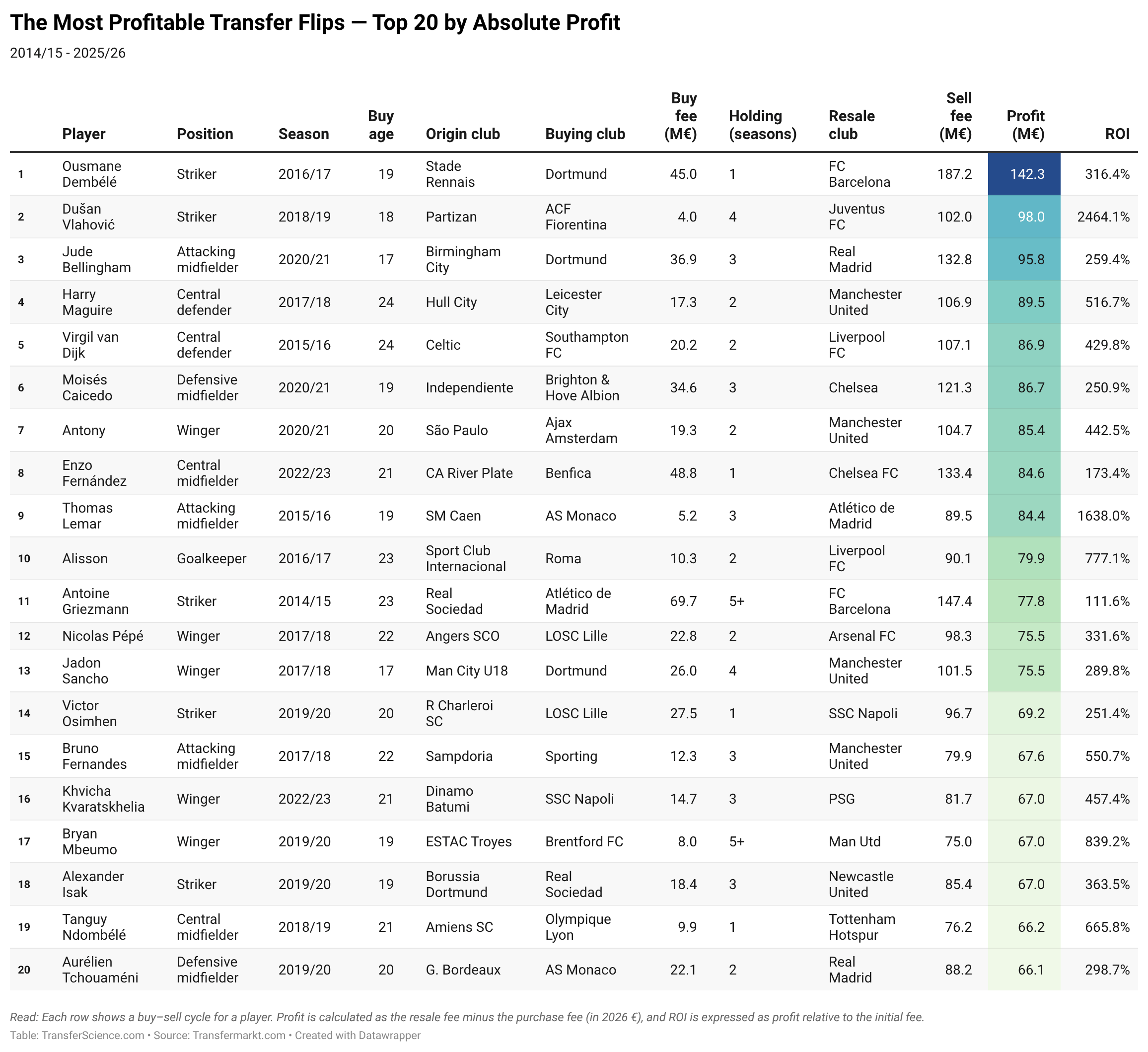
What about #11 to #20?
I won’t comment on every single deal, but a few patterns are worth noting.
First, Dortmund are brilliant. Dembélé. Bellingham. And also Jadon Sancho (another poor piece of business for the Red Devils).
That is not an accident.
Dortmund have repeatedly operated in the most lucrative part of the transfer market: elite young attackers and midfielders who are good enough to play immediately, but also young enough for richer clubs to imagine another level of upside.
The Jadon Sancho deal is a perfect example. Dortmund bought him from Manchester City, developed him into one of Europe’s most exciting wide players (I mean who didn’t enjoy his dribbling), and sold him to United for a huge profit.
Again, the sporting story after the sale is more complicated.
But the flip? Excellent.
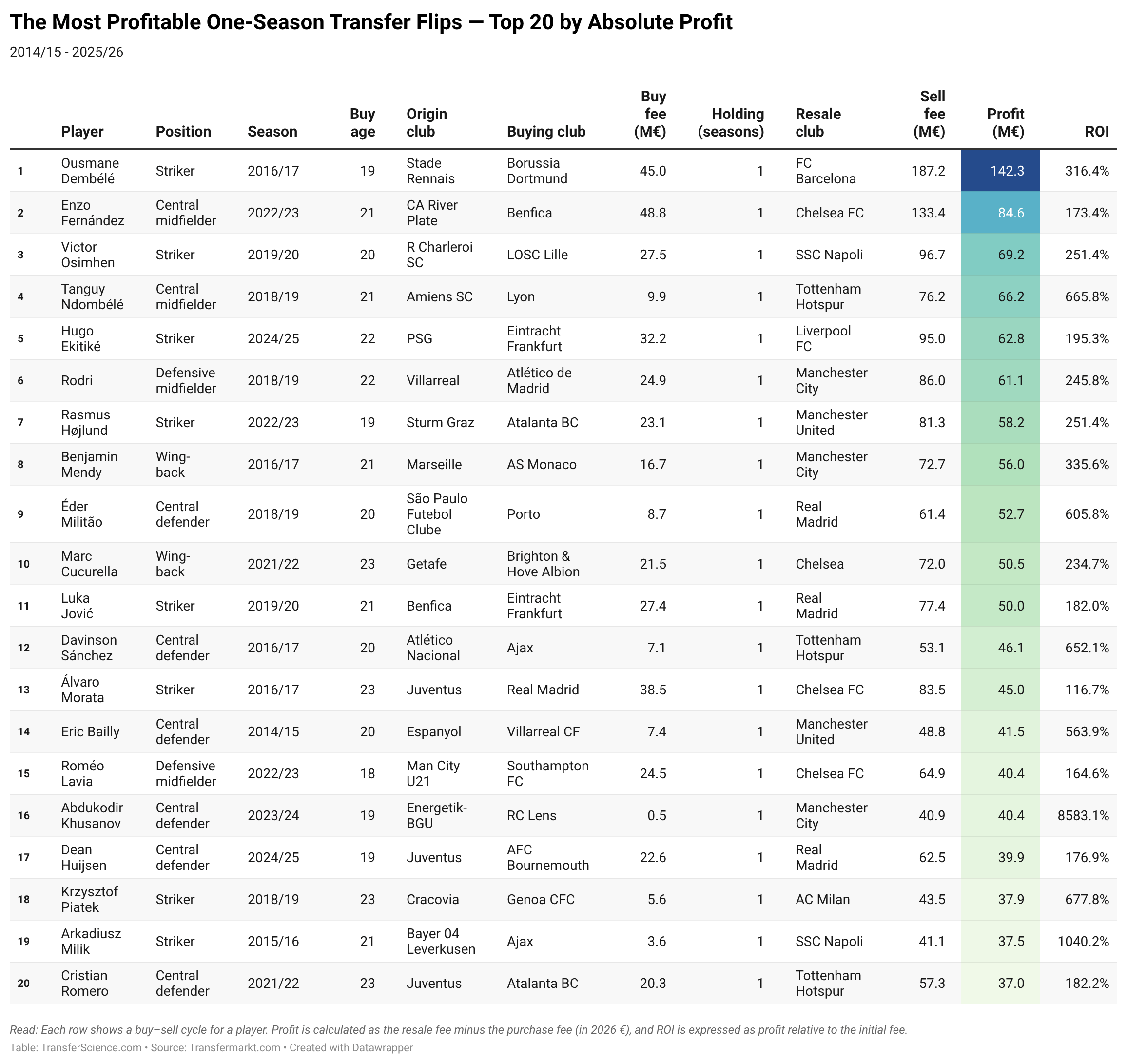
Second, one-season flips are the most fascinating category.
Enzo Fernández is the obvious example, but he is not alone. Add Tanguy Ndombélé and Victor Osimhen to the list. Some clubs manage to buy a player, watch the market reprice him almost immediately, and sell before the story has time to cool down.
That is rare. And risky. But when it works, it looks like football’s version of venture capital.
Buy uncertainty. Sell hype. Cash out before everyone updates the spreadsheet.
Third, the Premier League is often on the buying side of these stories.
That is not necessarily a criticism. The Premier League is the richest league in the world, so it naturally pays the exit fees that allow other clubs to record these profits.
But some clubs appear more often than others.
Manchester United, in particular, show up four times in the top 20 as the end of cycle buying club. And for the wrong reasons. Harry Maguire. Antony. Jadon Sancho. And Bruno Fernandes.
Now, these deals should not all be put in the same bucket.
Bruno Fernandes was clearly the only a successful transfer for United. Sporting made a huge profit, yes, but United bought a player who instantly became one of their most important performers. Maguire is more debatable. Sancho and Antony are harder to defend.
The lesson is not simply “United bad.”
The lesson is that when you repeatedly buy players after their value has already exploded, the margin for error becomes tiny.
United clearly did not read the memo. Or should I say the memos?
And for completeness sake, here’s a bonus table with the most profitable one-season transfer flips.
13 clubs on the end side of the deals come from the Premier league. I’ll just leave this here (you can learn more about the Premier league buying premium here).
3 — The Best Returns on Investment
So far, we have looked at the biggest flips in absolute euro terms.
But there is another way to look at this.
Because a €80m profit is enormous, of course. But if the player originally cost €40m, that is a very different deal from buying someone for €1m and selling him for €40m. In both cases the net profit is around €40m. In the first case, the return is 100%. In the second, it is 3,900%.
So next, let’s look at the most ridiculous returns on investment.
The table below presents the highest-ROI transfer flips where the initial fee was at least €0.5m. I include this filter for a simple reason: without it, the ROI ranking explodes because tiny initial fees create absurd percentages. And even with that filter, some of the numbers are still ridiculous.
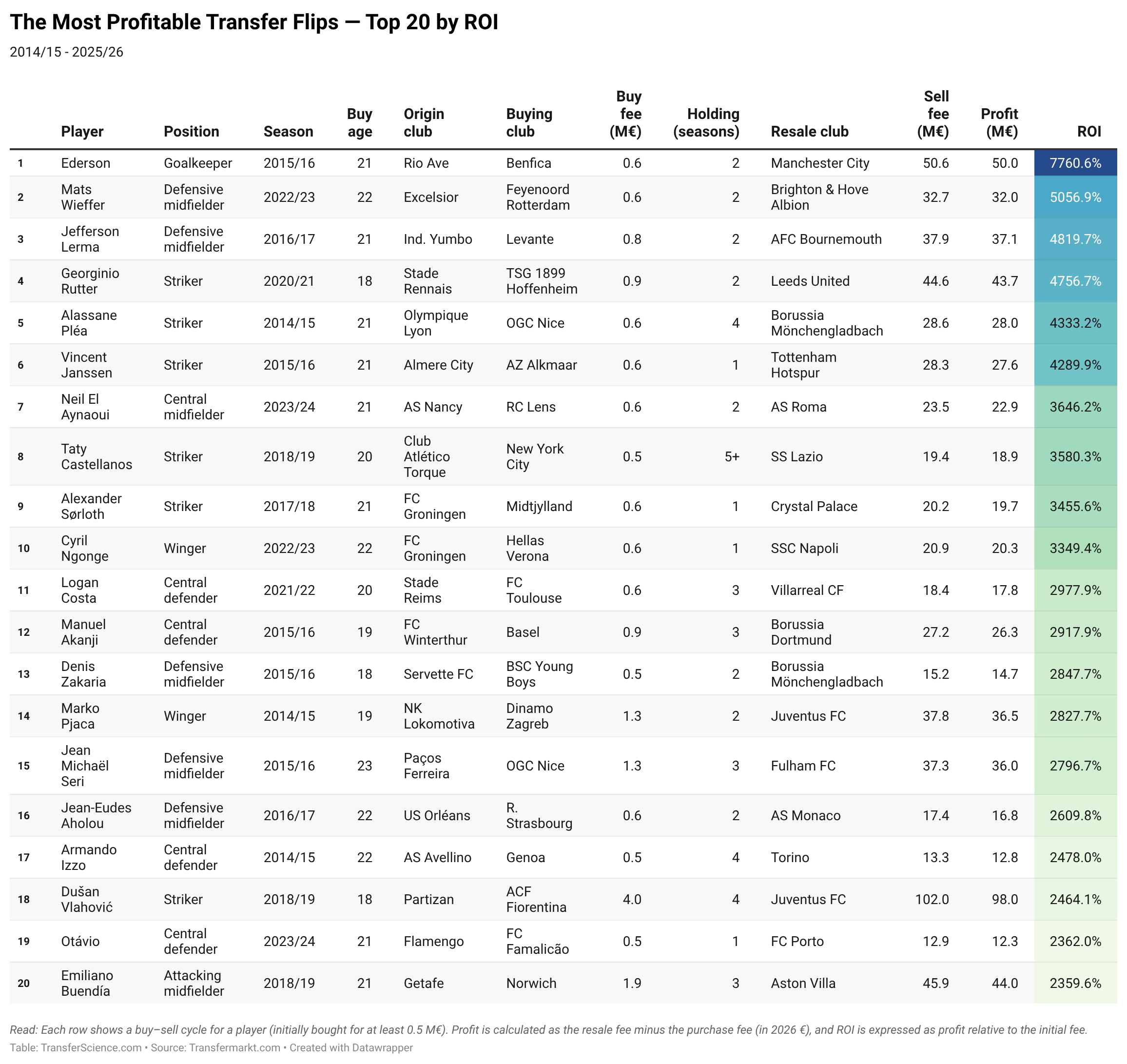
At number one, we have Benfica’s Ederson flip.
Benfica initially bought him for around €0.6m and sold him to Manchester City two seasons later for €50.6m. That is a net profit of roughly €50m.
Or, put differently, a return on investment of around 7,760%.
Wow.
A few other deals are worth mentioning.
One is AZ Alkmaar’s Vincent Janssen flip. One elite season in the Eredivisie was all it took for Tottenham to pay more than 43 times AZ’s initial investment.
Just one season. Around €27.6m in net profit.
For the record, he did find the net at Spurs.
But only 2 times in 3 Premier League games seasons.
Another painful reminder that Dutch goalscoring numbers do not always translate neatly to English football.
Further down the ranking, we find Fiorentina’s Dušan Vlahović flip again.
So not only was Vlahović one of the biggest flips in absolute terms, with €98m in profit, he was also one of the best pure ROI deals in the dataset: around 2,464%.
I love this one.
4 — The Worst Transfer Flips
Now for the other side of the game.
Not every flip works.
Sometimes clubs buy young players, fail to develop them, and sell at a loss. Sometimes the player does not adapt. Sometimes the market changes. Sometimes the original fee was simply too high.
If we rank the worst flips overall, many of the deals involve long holding periods of five seasons or more. That matters, because age starts to become a major factor. A player bought at 24 and sold six years later is no longer the same kind of resale asset. And that’s why I won’t comment on the fact that we have 14 Premier league teams in the top 20 on the wrong side of the deal.
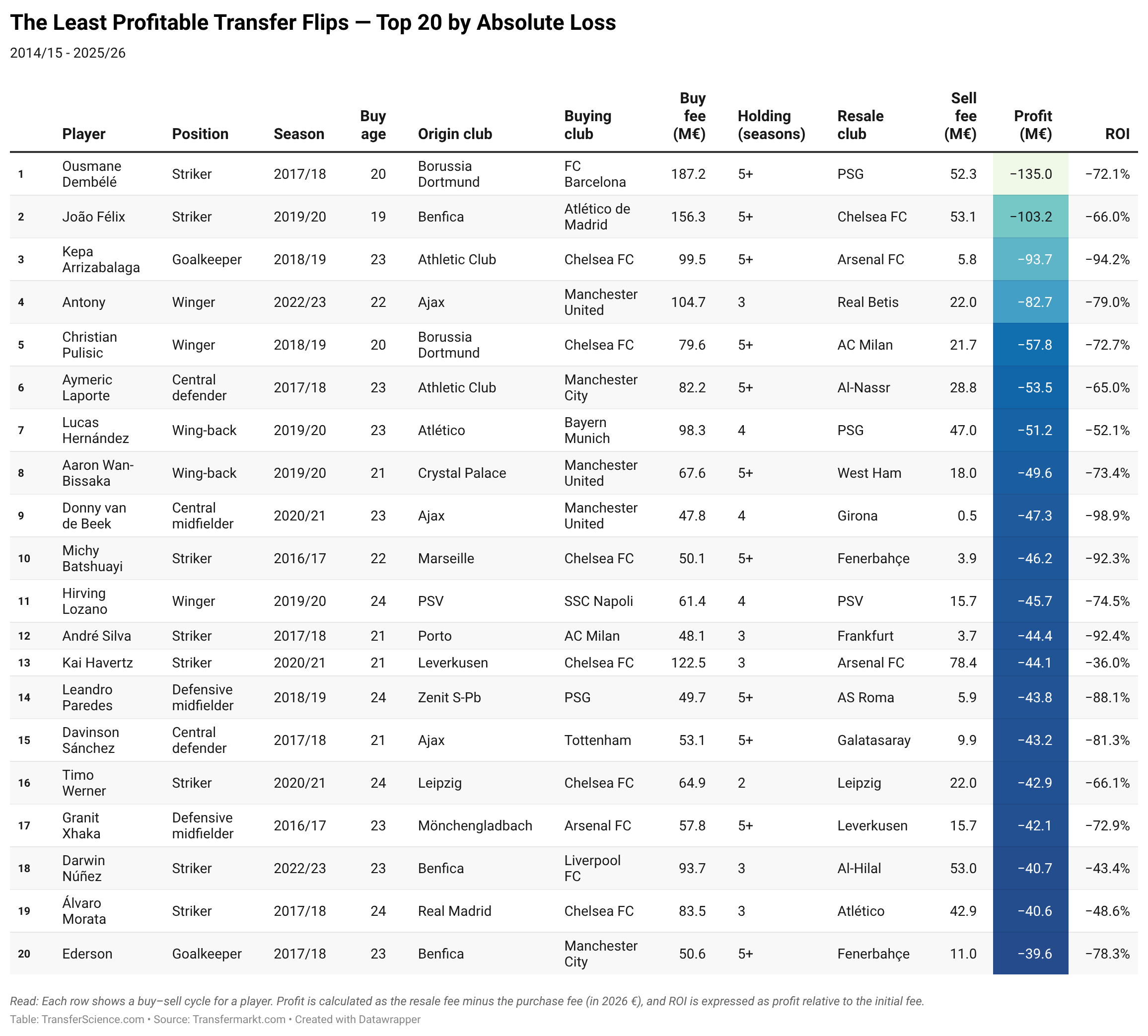
So the more interesting list is narrower:
Which clubs lost the most money after just one season?
That is the brutal version of the transfer flip. Buy high. Sell low. Quickly.
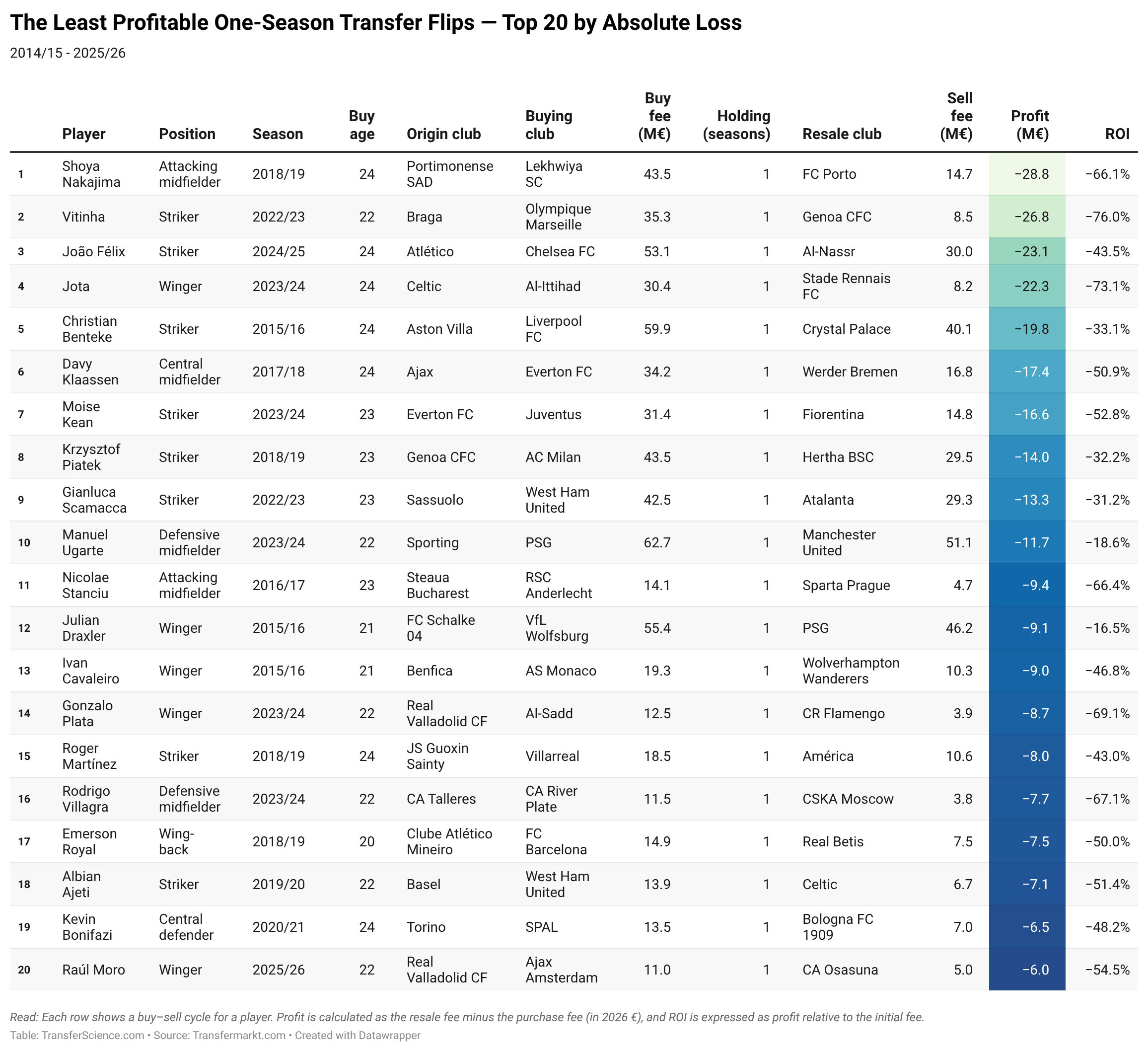
At the top is Shoya Nakajima, whose move generated a major one-season loss.
I’ll be honest: I had to look this one up.
The specifics are a bit unusual, but the numbers are clear: a loss of around €28.8m after a single season.
Porto got a good deal though. The Qatari club? Not so much. Although, to be fair, they are probably not losing sleep over the balance sheet.
At #3 comes João Félix, whose move from Chelsea to Al-Nassr generated a loss of around €23.1m for the Blues. He never delivered on his potential, did he.
This is another reminder that not all “young upside” bets are equal. Sometimes the market gives you a second exit. Sometimes it does not. And sometimes the only way out is to take the loss and move on.
At #5 comes Christian Benteke, who moved from Liverpool to Crystal Palace after generating a loss of €19.8m for the Merseyside club.
In hindsight, maybe Brendan Rodgers someone should have listened a little more closely to Ian Graham (Liverpool’s Director of Research and author of this brilliant book) when he warned that Benteke did not completely fit the team’s system.
But hindsight is a beautiful, annoying thing.
When we look at two-season holds, Premier League clubs dominate again. For the wrong reasons of course.
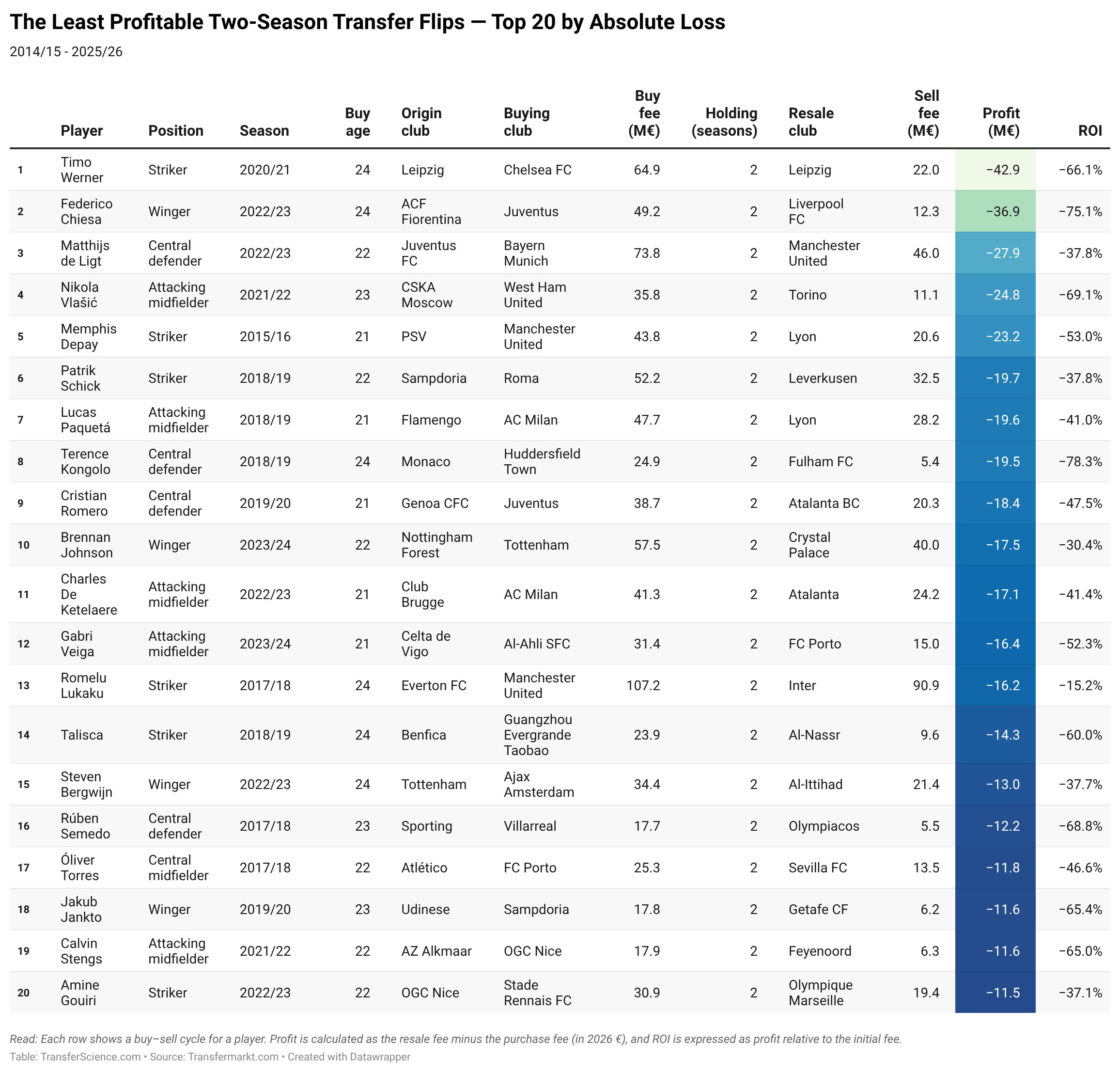
Here we find names such as:
Timo Werner, a loss of around €42.9m for Chelsea;
Nikola Vlašić, a loss of around €24.8m for West Ham;
Memphis Depay and Romelu Lukaku, total loss of around €43m for Manchester United.
If we want to be generous, there is one positive interpretation.
At least Premier League clubs tend to move quickly when something does not work.
They buy expensively, realise the fit is wrong, take the loss, and save on the wages.
Not exactly beautiful transfer strategy.
But sometimes cutting your losses is better than pretending the spreadsheet is fine.
My personal take-aways
First, transfer flips are more common than one might think. But the typical flip is not an €80m+ hyped-young-superstar jackpot. Most flips are much smaller, with the median profit sitting around half a million.
Second, at the very top of the market, the numbers become absurd. We are talking €80m+ profits or 2,000%+ returns on investment often in a single season. I mean, come on. To borrow the kind of phrase ChatGPT would definitely overuse: this is not normal transfer business. This is financial alchemy.
Third, the biggest profits often come from giving young players the platform and playing time to become seen (thank you captain Obvious). Everyone says clubs should pave the way for youngsters. Sure, they may not win you games straight away — unless their name is Erling Haaland — but they can give you the option to write very large cheques when the time comes.
Dortmund, Brighton, Ajax (and others) all showed different versions of the same idea:
Buy uncertainty. Develop it. Sell (perceived) certainty.
Fourth, timing matters. The best flips are not just about identifying talent. They are also about knowing when to sell. Wait too long, and the market cools. Sell too early, and you leave money on the table.
The sweet spot is when the player’s story is obvious enough for richer clubs to believe it, but early enough that they can still imagine another level of upside — or, at the very least, another resale if things do not work out. Which, as we saw, happens more often than your sporting director would care to admit.
But one should not forget that the same logic that creates Bellingham also creates Antony.
The same belief in upside that creates Virgil van Dijk also creates Harry Maguire.
That is the subtle art of the transfer flip.
Prost auf die Cheers to those who master it.
Next week, we’ll dive deeper into the clubs that do.
Thank you for reading until the end.
See you next week.
Cheers,
Martin
P.S. What is your favorite transfer flip/flop? Drop your thoughts below — I read them all ❤️
Great analysis!
Another takeaway: some of the least profitable transfers are due to impatience or not knowing how to use the player: Lucas Paquetá, De Ketelaere, Lukaku, Schick, Cristian Romero.
An interesting piece would be on the trend for the bigger clubs to buy promising youngsters and how they generate transfer funds on their sale. Man City & Chelsea have done this in scale over recent years.