
Premier League Clubs Pay the Transfer Tax. Here’s the Bill
What 21 years of transfer deals reveal about the premiums paid across world football
Hi friend,
Welcome to Transfer Science #001, the newsletter that brings a calculator to a pub debate and somehow still gets invited back.
Everyone says Premier League clubs overpay for transfers.
But by how much, exactly?
Using 21 seasons of transfer data, you’ll learn:
how much Premier League clubs pay above market value when buying players;
which other leagues overpay the most in the transfer market; and
and which leagues extract the strongest premiums when selling.
Before we begin
For the purposes of this article, we’ll use Transfermarkt player market values as a reference point for what a player was worth at the time of the transfer.
Are these market values perfect? Of course not.
But they are, at the very least, a somewhat consistent public benchmark that has existed for many years—and one that fans love to debate. If you’d like to understand how those values are built, you can read more about their methodology here.
Okay, Martin, so What Are We Actually Doing Today?
We’ll examine whether the clubs from a given league tend to overpay or underpay for a player relative to his perceived market value (paid transfers only).
This is not a judgment of whether the transfer was successful.
A club can easily overpay for a player and make a brilliant signing.
A club can also buy well below market value and fail badly.
So the question we’ll examine is simply: At the moment the deal happened, did the buying club pay more or less than the player’s market value? Nothing more, nothing less.
To answer it, we’ll analyse 21 seasons of transfers data spanning the 2005/06 - 2025/26 seasons.
Let’s go!
1 — How Closely Do Market Values and Transfer Fees Match?
Before zooming in on the different leagues, it helps to understand the broader market.
Since the 2005/06 season, there have been 19,682 transfers involving a non-zero fee in the world’s 10 strongest football leagues (as per Opta’s ranking : Premier league (ENG), Bundesliga (GER), La Liga (ESP), Serie A (ITA), Ligue 1 (FRA), Jupiler Pro League (BEL), Primeira Liga (POR), Liga Profesional (ARG), Championship (ENG), Serie A (BRA).
Based on those transfers, transfer fees have tracked players’ perceived market values remarkably closely.
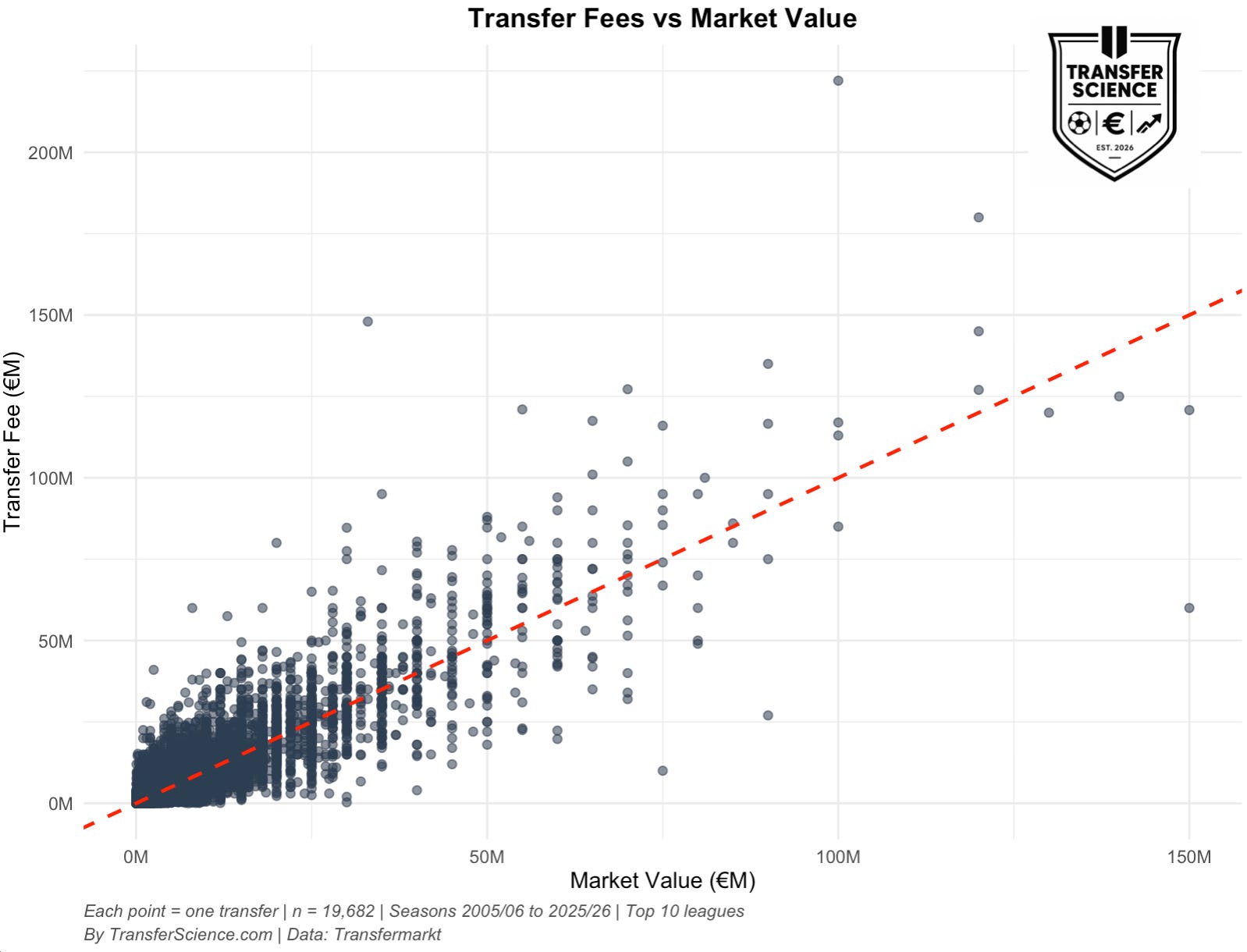
As shown in the figure, teams tend to overpay only slightly. The simplest linear model across those transfers suggests that a €1 of market value is associated with €1.01 in transfer fees on average.
Another way to frame it:
Historically, clubs have paid an average premium of around 1% relative to players’ perceived market values.
Now, the calculation of market value in is a complex (and exciting) subject in itself, but not the focus of this piece.
Even without diving too deeply into valuation theory, some patterns should not surprise us. Richer leagues can pay premium prices because they have greater financial strength. Clubs also often pay above perceived market value for young, high-upside players because they are not just buying current ability; they are buying future resale value too.
These effects have been quantified in this industry-leading CIES Football Observatory paper.
My point is this: before we interpret league-level premiums too literally, we need to keep one thing in mind.
A premium is not always “bad negotiating.”
Sometimes it reflects player profile and market context — things we are not fully unpacking here.
Great. Now let’s finally quantify how much more the Premier League pays compared with the other nine leagues.
2 — The Premier League Spending Premium
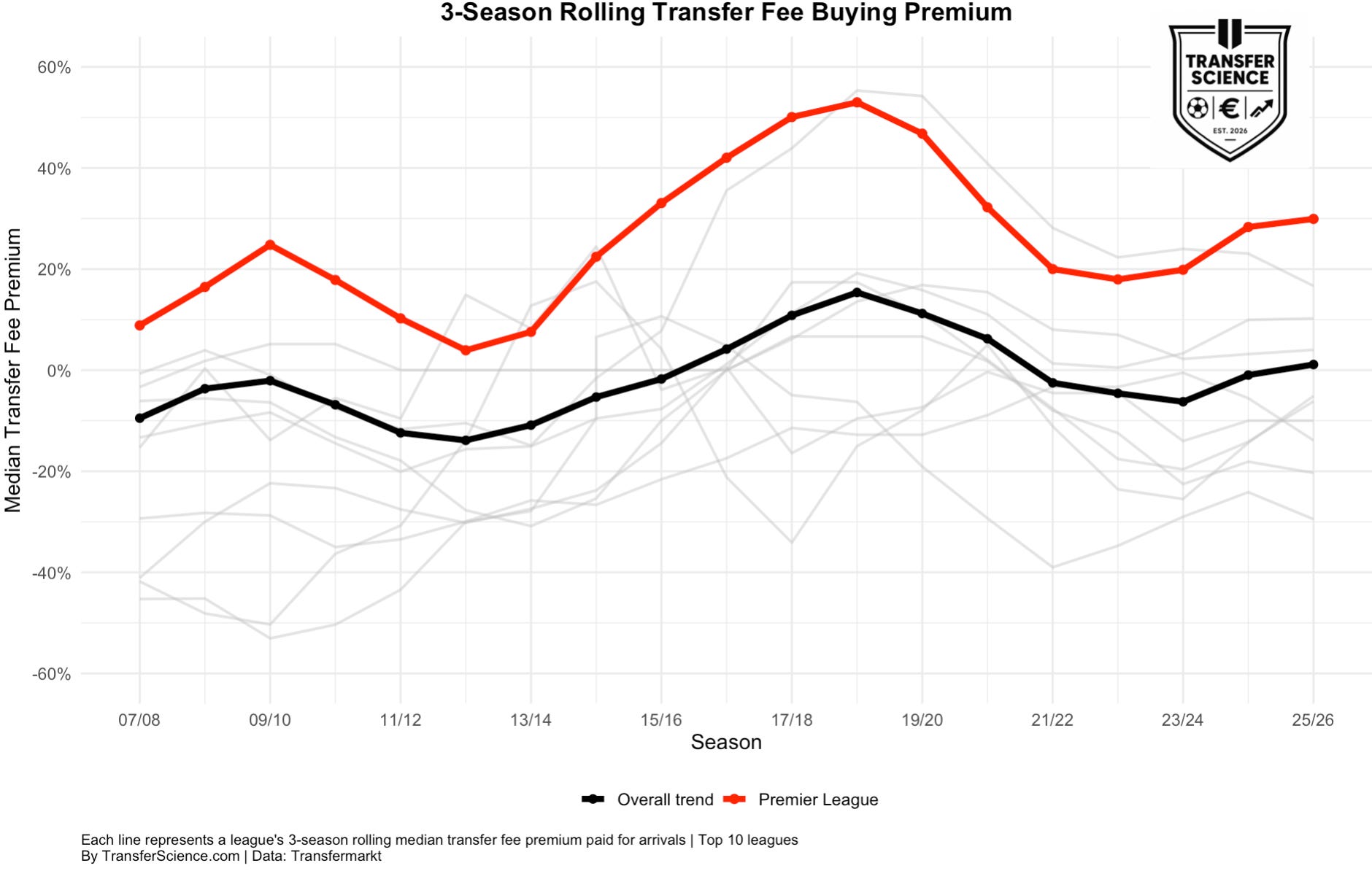
The chart below shows each league’s 3-season rolling median transfer overpay for incoming transfers.
That may sound technical, but the logic is simple — for each league, we compare the fees paid for new arrivals with those players’ market values at the time of the transfer. We then calculate the fee-to-value ratio and take the median across transfers in the league. Finally, we smooth the results over three seasons to highlight longer-term trends rather than one-season spikes. Or in plain English:
The chart shows whether clubs in each league tend to pay above (>0%) or below (<0%) market value for incoming players, and how that pattern has evolved over time.
The black line shows the overall trend across the top 10 leagues, while the red line shows the Premier League.
So what do we see?
As of the 2025/26 season, the overall market trend in the top 10 leagues sits around 1%. In other words, clubs across these leagues have recently completed transfers at fees roughly just above the players’ perceived market values.
The Premier League clubs?
They sit closer to +30%.
That means:
Premier League clubs tend to pay around 30% above players’ market values, while the wider market has paid at benchmark on average.
That is a huge, though hardly surprising, gap.
We have all heard the argument that England’s television revenue helps drive transfer inflation across world football. (A great topic for a future newsletter, isn’t it?)
The broader conclusion from this descriptive analysis is clear:
The Premier League consistently pays the biggest premium in world football.
If you’re wondering which league comes closest—and occasionally even exceeds it (notably between 2017/18 and 2023/24, which is not exactly a title you want to win)—it is the only other English league in our top-10 sample: the EFL Championship. The well-known English player premium is one likely explanation, isn’t it.
And just for completeness’ sake, here is a table showing that same ranking as of the 2023/24 - 2025/26 period.
Okay, so what about the other leagues?
The picture becomes just as interesting once we move beyond England.
Ligue 1 clubs sit third in our ranking, paying an average 10.2% premium on incoming transfers. Serie A follows with a more modest +4.0% premium, suggesting Italian clubs tend to pay slightly above benchmark value, but nowhere near Premier League levels.
The most surprising result may be LaLiga. Spanish clubs record a -20.3% buying premium, which means they have recently completed transfers at fees roughly 20% below players’ perceived market values. That is a remarkable number for one of Europe’s elite leagues. It likely reflects a combination of tighter financial constraints, stronger negotiating discipline, and a greater willingness to wait for value rather than chase inflated deals.
The same broad pattern appears in Belgian Pro League (-13.9%) and Primeira Liga (-10%). Neither result is especially surprising. Both leagues have long reputations as talent development markets, stepping-stone leagues and strong sellers into richer competitions. We knew they identify talent earlier, but now we can quantify their edge at the negotiation table.
Those were the arrivals. What about the departures?
3 — The Selling Premium
Buying is only half the story. If the first chart measured how leagues buy, this second one looks at how leagues sell.
The logic is the same: we compare outgoing transfer fees with players’ market values at the time of the move; we calculate the fee-to-value ratio and we smooth the median results over three seasons to reveal the broader trend.
And here’s what the data show.
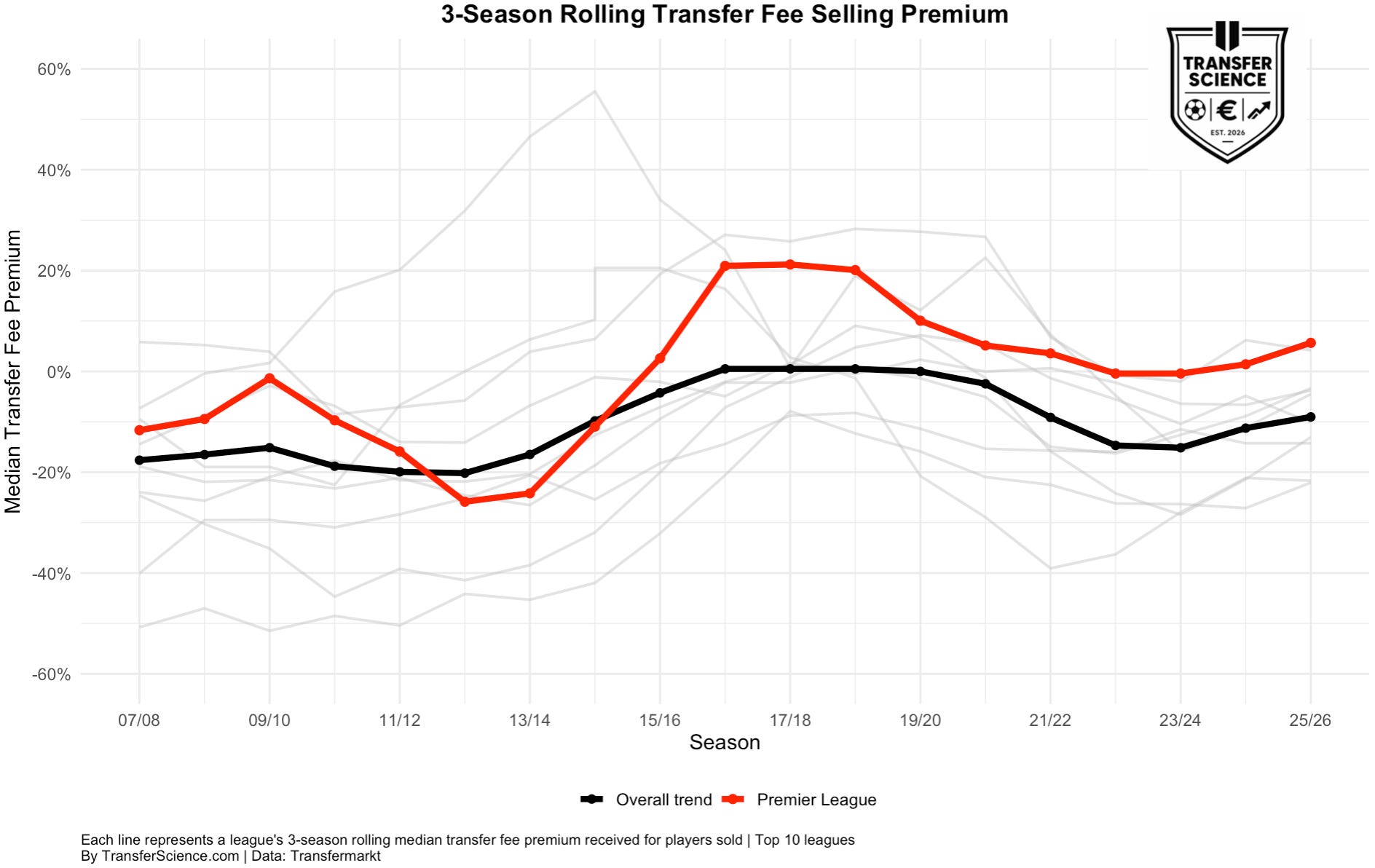
This time, the picture is far less extreme for the Premier league. As of the 2025/26 season, Premier League clubs sit around +6%, while the overall market trend sits around -8%.
So yes, Premier League clubs still tend to sell slightly above benchmark value, but compared with the +30% premium they pay when buying, the selling edge is modest. Premier League clubs dominate football’s buying market, but they do not dominate football’s selling market to the same degree.
Having said that, the two English leagues are the only ones with a positive sale premium.
The most surprising result is the Bundesliga.
German clubs sold players for fees 22.1% below their perceived market values over the 2023/24 to 2025/26 period—the lowest figure in our sample. That is kind of unexpected for a league widely respected for strong recruitment, player development, and smart sporting management.
Second from bottom sits the Belgian Pro League at -14.3%, followed closely by LaLiga at -13.1%. That said, while these leagues rank near the bottom of our 10-league sample, the gaps are not as dramatic as they may first appear. The overall average sits around -8%, meaning most leagues outside England are clustered within a relatively narrow band below benchmark value.
So rather than suggesting these leagues are “bad sellers,” the table may instead reflect different market realities: fewer cash-rich domestic buyers, greater urgency to sell or less leverage in negotiations than English clubs enjoy.
In simple terms:
English clubs often sell from a position of strength. Many other leagues sell from a position of necessity.
That distinction may explain more than the raw percentages themselves.
Boom — that’s it for the first edition of Transfer Science.
You now have a number for the next time someone says Premier League clubs overpay.
They do.
Recently, by about +30% on incoming transfers.
Thank you for reading until the end.
See you next week.
Cheers,
Martin
PS. Would you like to see league-specific analysis showing which teams drive these premiums up (and down)? Drop your suggestions below. I read them all ❤️
Hi Martin. Loved the return, and in general the analysis of this piece. I have a personal request, how does Barcelona act when it comes to paying or overpaying on premiums? And how harmful do you think overpaying is? I actually think it's very harmful, and more harmful than what many people realise because it hurts roster construction and flexibility. And even the safe gaps of resale value makes you lose needless time and doesn't work out. Thoughts?
Really nice analysis. It would be interesting to see without intranational transfers as I think that would help show how much big fish in small ponds distort these numbers. Would obviously heavily affect PL numbers but would like to see for Ligue 1 and how much PSG accounts for the premium